The Draco Dwarf Galaxy (PGC 60095) is a spheroidal galaxy which was discovered by Albert George Wilson of Lowell Observatory in 1954 on photographic plates of the National Geographic Society’s Palomar Observatory Sky Survey (POSS). It is part of the Local Group and a satellite galaxy of the Milky Way galaxy. The Draco Dwarf is situated in the direction of the Draco Constellation at 34.6° above the galactic plane and at a distance of 260 000 light-years.
A dwarf spheroidal galaxy (dSph) is a term in astronomy applied to small, low-luminosity galaxies with very little dust and an older stellar population. They are found in the Local Group as companions to the Milky Way and as systems that are companions to the Andromeda Galaxy (M31). While similar to dwarf elliptical galaxies in appearance and properties such as little to no gas or dust or recent star formation, they are approximately spheroidal in shape and generally have lower luminosity.
In the pictures below all the fainter stars visible are not part of the Milky Way, but part of the dwarf galaxy. Some more distant galaxies are also visible through the dwarf galaxy.
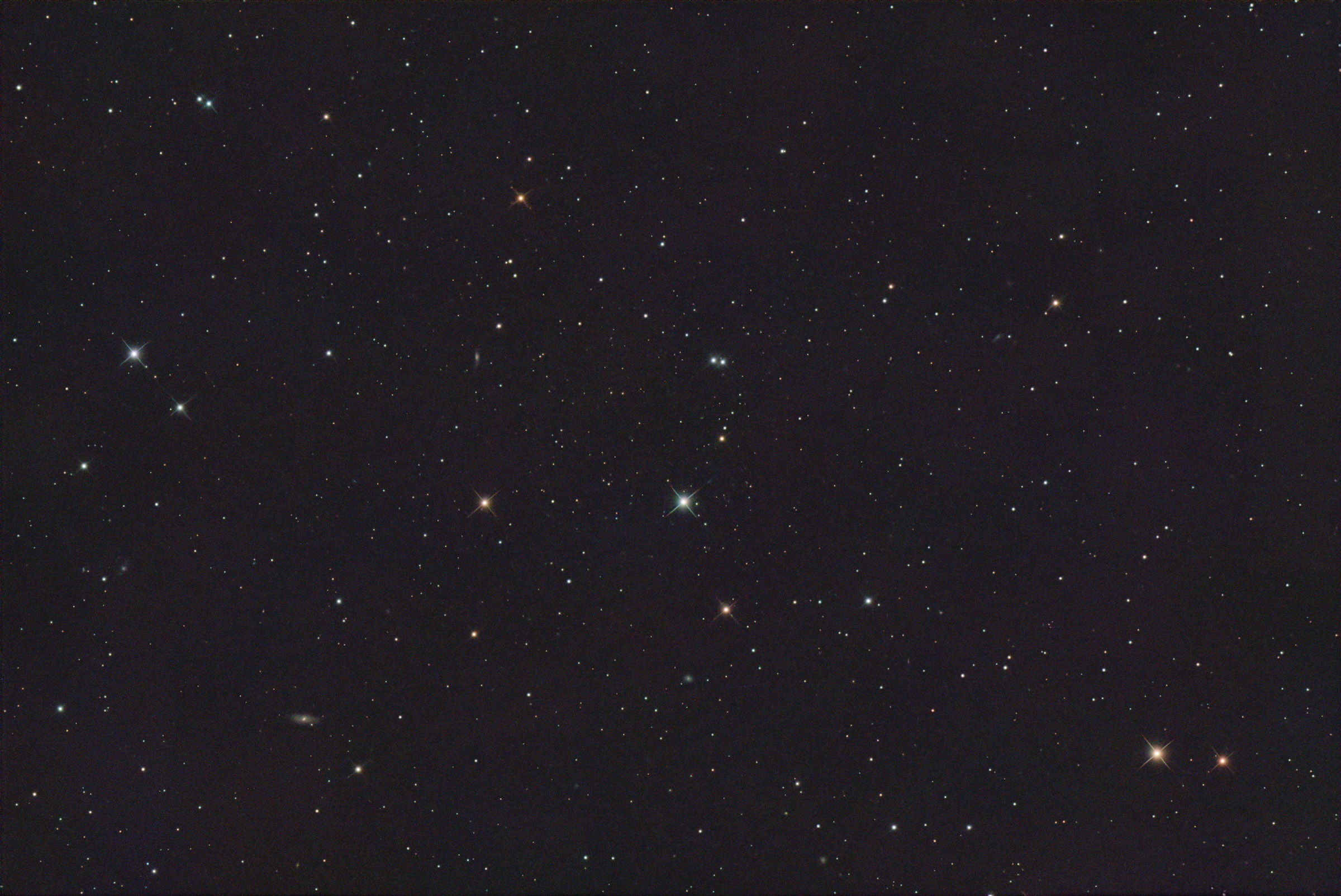
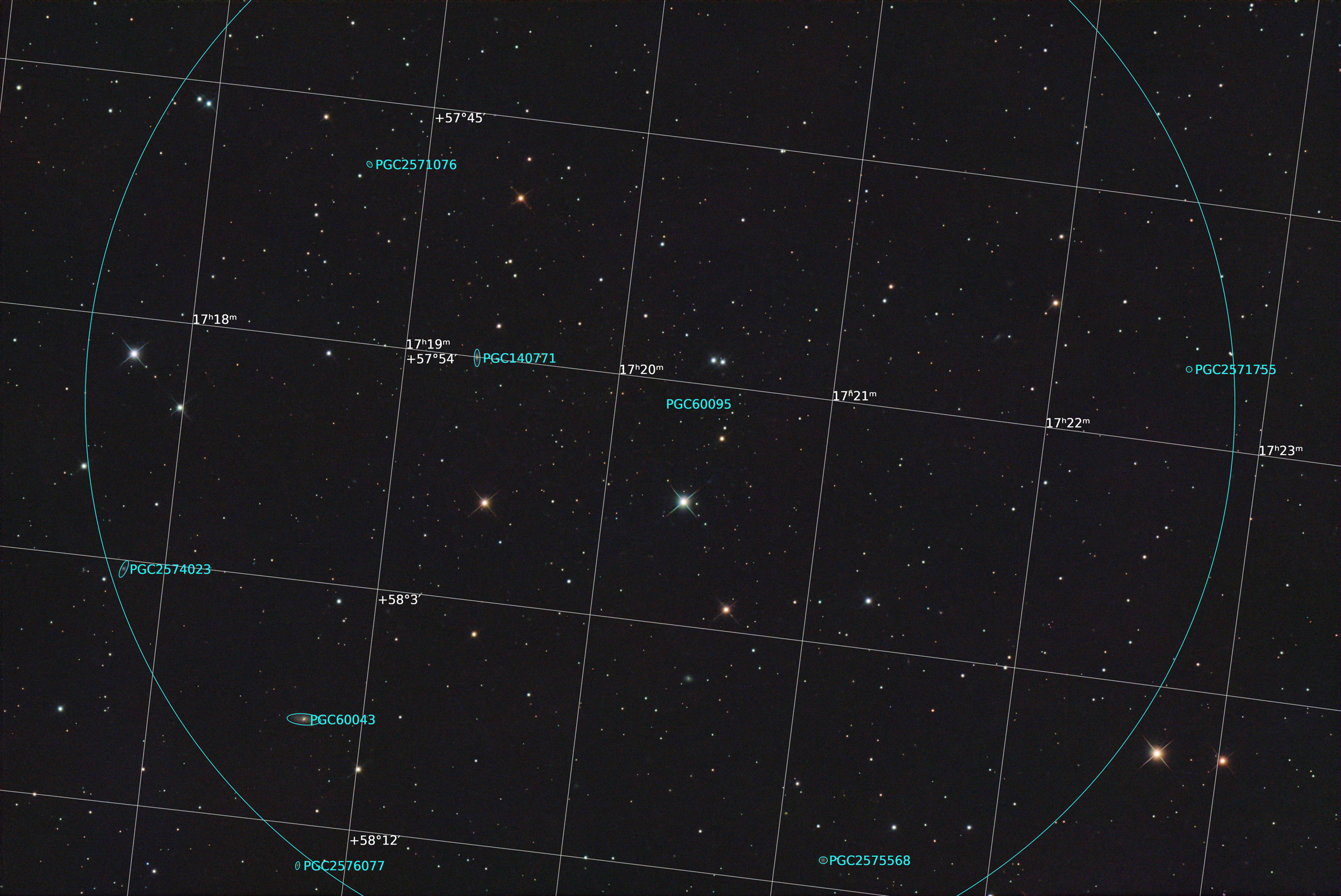
Recent studies have indicated that the galaxy may potentially hold large amounts of dark matter. Having an absolute magnitude of −8.6 and a total luminosity of only 2×10⁵ L☉, it is one of the faintest companions to our Milky Way.
The Draco Dwarf contains many red giant branch (RGB) stars; five carbon stars have been identified in Draco Dwarf and four likely asymptotic giant branch (AGB) stars have been detected. In1961, Walter Baade and Henrietta H. Swope studied Draco Dwarf and discovered over 260 variables. Of the 138 in the cluster’s center, all but five were determined to be RR Lyrae variables. From this work a RR Lyrae derived distance modulus of 19.55 is found which implies a distance of 81 kpc. The modern estimate is 80 ± 10 kpc from Earth and its size is around 830 ± 100 × 570 ± 70 pc.
The Draco Dwarf contains primarily an old population of stars and insignificant amounts of interstellar matter (being basically dust free). From 75% to 90% of its stars formed more than ~10 Gyr ago followed by a low rate of formation with a small burst of star formation around 2–3 Gyr ago. The central region of Draco Dwarf exhibits a concentration of more metal-rich stars there being more centrally concentrated red horizontal branch stars than blue horizontal branch stars.
Dark matter
Recently, dwarf spheroidal galaxies have become key objects for the study of dark matter. The Draco Dwarf is one which has received specific attention. Radial velocity measurements of individual stars in Draco have revealed a large internal velocity dispersion giving a mass to luminosity ratio of up to 440 M☉/L☉, suggesting large amounts of dark matter. It has been hypothesized that large velocity dispersions could be explained as tidal dwarfs (virtually unbound stellar streams from dwarf galaxies tidally disrupted in the Milky Way potential). However, Draco Dwarf’s narrow horizontal branch width does not support this model. This only leaves the dark matter explanation and makes Draco Dwarf the most dark matter dominated object known as of 2007. The dark matter distribution within Draco Dwarf is at least nearly isothermal.
At large radii, radial velocity dispersion exhibit strange behavior. One possible explanation for this would be the presence of more than one stellar population. This suggests the need for further study of Draco Dwarf population’s metallicity and ages and of dwarf spheroidals in general.
In 2024, a group of scientists using the Hubble Space Telescope measured proper motions of Draco with 18 years of data, making it the first dwarf galaxy to have its 3D velocity dispersion profile radially resolved.