Skip to content
Menu
Rolf's Astrophotography
  • An Astrophotography Journey!
  • Clusters
    • Globular Clusters
      • NGC 2419 – The Intergalactic Wanderer
      • M13 – Hercules Cluster
      • M15 – Great Pegasus Cluster
      • M2
      • M3
      • M56
      • M92
      • NGC 6934
      • NGC 7006
    • Open Clusters
      • IC 348
      • M34
      • M35 and NGC 2158
      • NGC 6940
      • NGC 7243
      • M39
      • M45 – The Pleiades
      • M52
      • NGC 869 and NGC 884 – Perseus Double Cluster
  • Galaxies
    • Galaxy Clusters
      • Abell 2197
      • Abell 2199
      • Abell 262
      • Abell 347
      • Abell 426
      • Stephan’s Quintet
    • Elliptical Galaxies
      • Leo I (UGC 5470, PGC 29488, MCG)
      • M105, NGC 3384, and NGC 3389
      • NGC 3077
      • NGC 4125 and NGC 4121
      • PGC 60095 – Draco Dwarf Galaxy
      • M87 – Virgo A
      • Markarian’s Chain with M84, M86, and M87
      • NGC 1272, NGC 1275 – The Perseus Cluster
      • NGC 3613, NGC 3619, and NGC 3625
      • NGC 3998
      • NGC 4889 and other galaxies in Coma Berenices
      • PGC 2641182
    • Irregular Galaxies
      • NGC 4214
      • M82 – Cigar Galaxy
      • NGC 2366 and NGC 2363
      • NGC 4449
    • Spiral Galaxies
      • IC 2574 – Coddington’s Nebula
      • M74
      • M95
      • NGC 3198
      • NGC 3614
      • NGC 3718 and NGC 3729
      • NGC 3726
      • NGC 3938
      • NGC 3945, NGC 3975, and NGC 3978
      • NGC 4041 and NGC 4036
      • NGC 4051
      • NGC 4145
      • NGC 4151 and NGC 4156
      • NGC 4395
      • NGC 4725
      • NGC 7479
      • NGC 7814
      • UGC 3697 – Integral Sign Galaxy
      • IC 342
      • M100
      • M101 – Pinwheel Galaxy
      • M102 – Spindle Galaxy
      • M106
      • M108
      • M109
      • M31 – Andromeda Galaxy
      • M33 – Triangulum Galaxy
      • M51 – Whirlpool Galaxy
      • M63 – Sunflower Galaxy
      • M64 – Black Eye Galaxy
      • M65, M66, and NGC 3628 – The Leo Triplet
      • M81 – Bode’s Galaxy and M82 – Cigar Galaxy
      • M94
      • M96
      • NGC 2403
      • NGC 2683 – UFO Galaxy
      • NGC 2775
      • NGC 2841
      • NGC 3184
      • NGC 3642
      • NGC 4236
      • NGC 4244 – Silver Needle Galaxy
      • NGC 4490 – Cocoon Galaxy
      • NGC 4559
      • NGC 4565 (C38) – Needle Galaxy
      • NGC 4631 (Whale Galaxy) and NGC 4656
      • NGC 5005
      • NGC 5216, NGC 5218 – Keenan’s System
      • NGC 5907 – Knife Edge Galaxy
      • NGC 6946 – Fireworks Galaxy
      • NGC 7331
      • NGC 891 – Silver Galaxy
      • NGC 925 – Amatha Galaxy
    • The Milky Way
  • Nebulas
    • Dark Nebulas
      • IC 434 – Horsehead Nebula
      • NGC 2264 – Cone Nebula and Christmas Tree Cluster
    • Emission Nebulas
      • Cederblad 214
      • IC 1470
      • IC 410 – Tadpole Nebula
      • Sh 2-261 – Lower’s Nebula
      • IC 1396 – Elephant’s Trunk Nebula
      • IC 1805 – Heart Nebula
      • IC 1848 – Soul Nebula
      • IC 2177 – Seagull Nebula
      • IC 405 – Flaming Star Nebula
      • IC 5070 – Pelican Nebula
      • IC 5146 – Cocoon Nebula
      • IC 59 and IC 63 – Gamma Cassiopeia Nebula
      • M42 – Orion Nebula
      • NGC 1491
      • NGC 1499 – California Nebula
      • NGC 1931 and IC 417
      • NGC 2174 – Monkey Head Nebula
      • NGC 2237 – Rosette Nebula
      • NGC 2359 – Thor’s Helmet
      • NGC 281 – Pacman Nebula
      • NGC 6888 – Crescent Nebula
      • NGC 7000 – North America Nebula
      • NGC 7635 – Bubble Nebula
      • NGC 7822
      • NGC 896
      • Sadr and the Gamma Cygni Nebula (IC 1318)
      • Sh 2-155 – Cave Nebula
    • Planetary Nebulas
      • NGC 2022
      • NGC 2371-2
      • NGC 2392 – Eskimo Nebula
      • Sh 2-290 (ACO 31)
      • Abell 21 – Medusa Nebula
      • Jones-Emberson 1 Nebula
      • M27 – Dumbbell Nebula
      • M57 – Ring Nebula
      • M76 – Little Dumbbell Nebula
      • M97 – Owl Nebula
      • NGC 1501
      • NGC 40 – Bow Tie Nebula
      • NGC 6543 – Cat’s Eye Nebula
      • NGC 6826 – Blinking Planetary
      • NGC 7662 – Snowball Nebula
    • Reflection Nebulas
      • NGC 1977 – Running Man Nebula
      • IC 2118 – Witch Head Nebula
      • M78
      • NGC 7023 – Iris Nebula
    • Supernova Remnants
      • IC 443 – Jellyfish Nebula
      • M1 – Crab Nebula
      • NGC 6960 – Veil Nebula
  • Solar System
    • Comets
      • Comet C/2024 E1 (Wierzchos))
      • Comet C/2025 A6 (Lemmon)
      • Comet Tsuchinshan-ATLAS (C2023 A3)
    • The Moon
    • Jupiter
    • Mars
    • Saturn
  • Stars
    • Double Double in Lyra
    • Gemini Constellation with Jupiter
    • Orion Constellation
  • The Gear
    • APO107 Configuration Example
    • APO94 Configuration Example
    • AstroTrac TT320X and Nikon D800 DSLR Configuration Example
    • MN190 Configuration Example
    • RC8″ Configuration Example
    • Skywatcher EQ6-R Pro Equatorial Mount
Rolf's Astrophotography

PGC 60095 – Draco Dwarf Galaxy

The Draco Dwarf Galaxy (PGC 60095) is a spheroidal galaxy which was discovered by Albert George Wilson of Lowell Observatory in 1954 on photographic plates of the National Geographic Society’s Palomar Observatory Sky Survey (POSS). It is part of the Local Group and a satellite galaxy of the Milky Way galaxy. The Draco Dwarf is situated in the direction of the Draco Constellation at 34.6° above the galactic plane and at a distance of 260 000 light-years.

A dwarf spheroidal galaxy (dSph) is a term in astronomy applied to small, low-luminosity galaxies with very little dust and an older stellar population. They are found in the Local Group as companions to the Milky Way and as systems that are companions to the Andromeda Galaxy (M31). While similar to dwarf elliptical galaxies in appearance and properties such as little to no gas or dust or recent star formation, they are approximately spheroidal in shape and generally have lower luminosity.

In the pictures below all the fainter stars visible are not part of the Milky Way, but part of the dwarf galaxy. Some more distant galaxies are also visible through the dwarf galaxy.
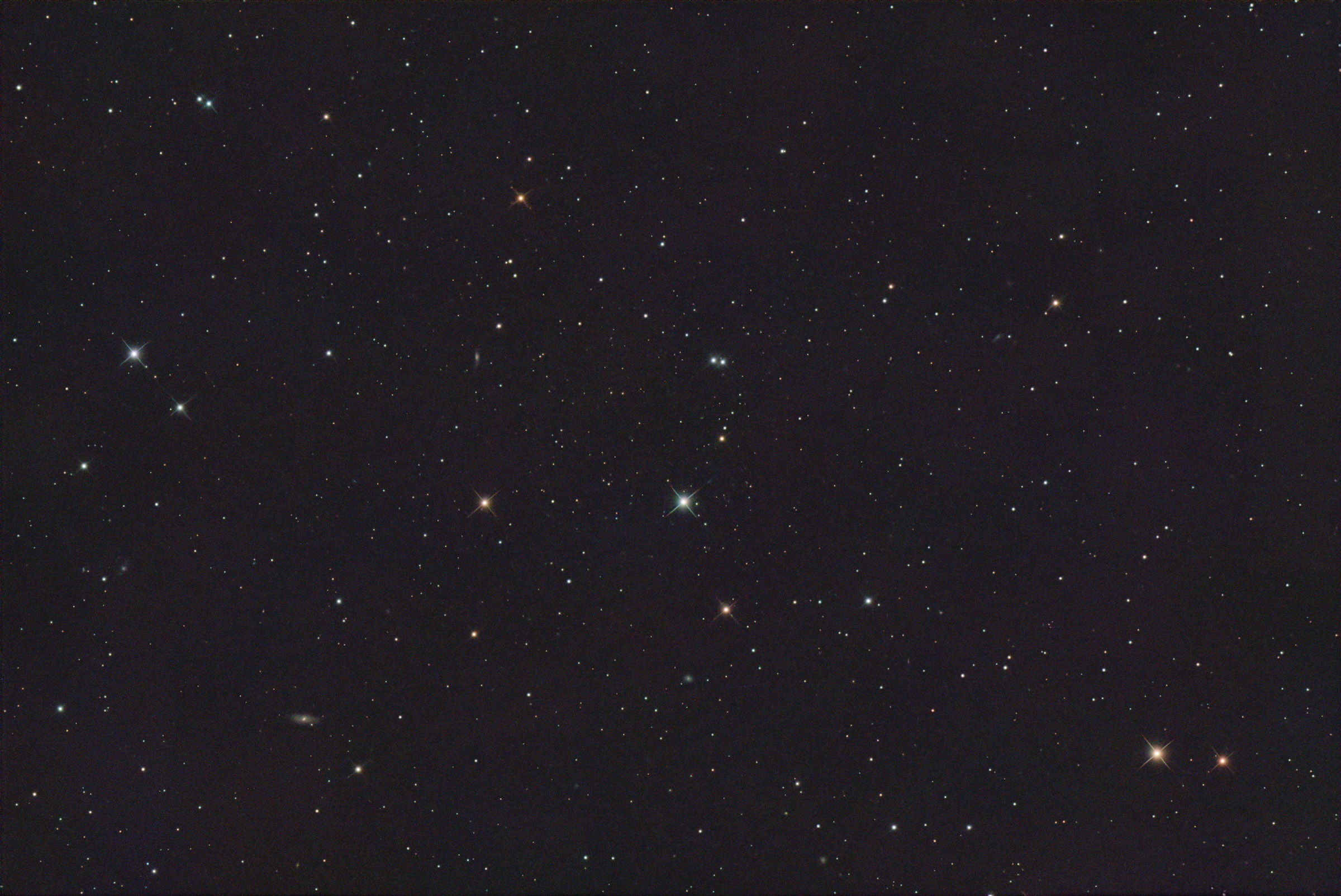
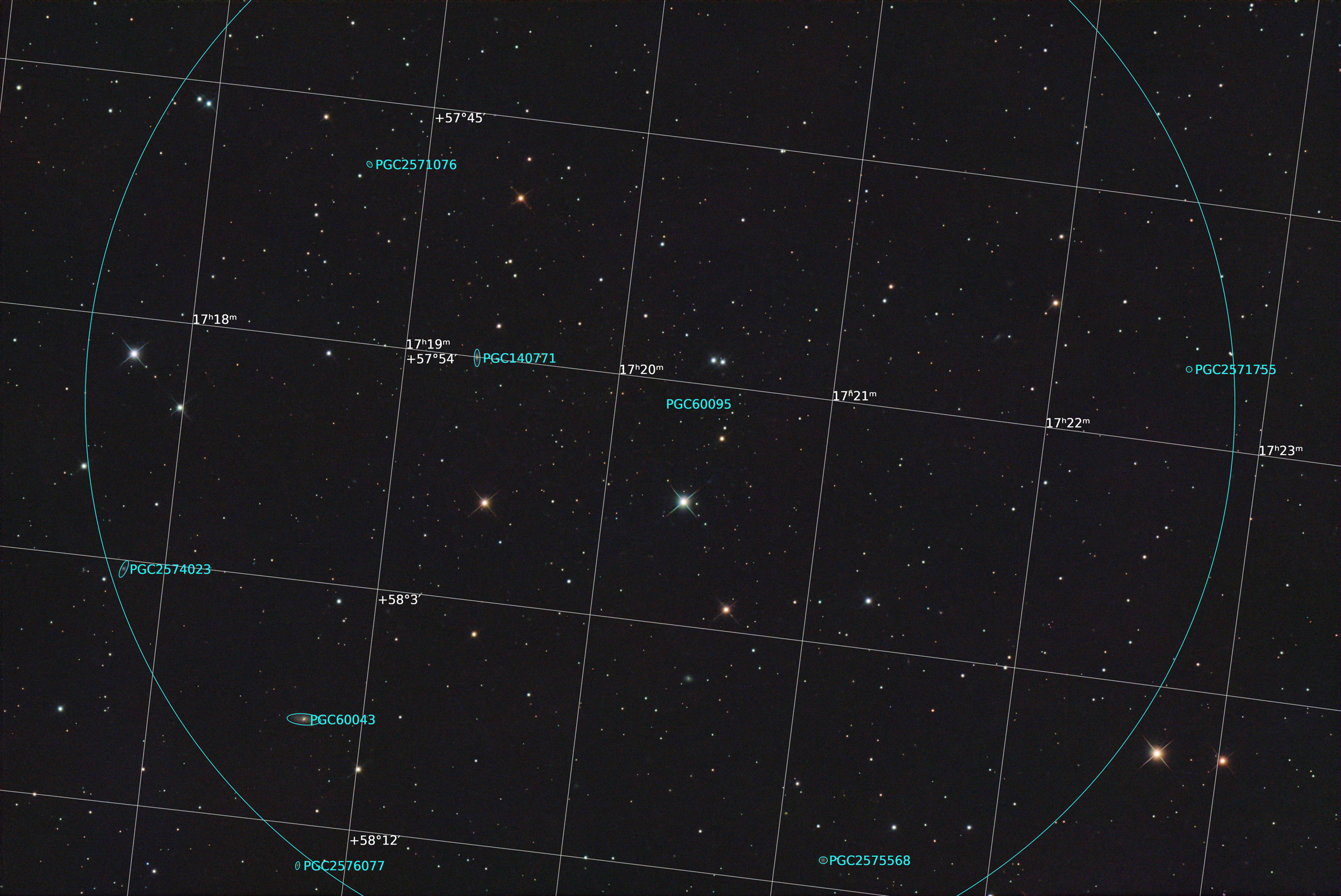
PGC 60095, Draco Dwarf galaxy
Photographed with the RC8″ reflector and the ASI 2600MC color CMOS camera in Stuvsta, April 10th, 2026. Exposure was 30*3 min with IDAS LPS P3 filter. Postprocessing in Pixinsight.
PGC 60095, Draco Dwarf galaxy
Photographed with the RC8″ reflector and the ASI 2600MC color CMOS camera in Stuvsta, April 10th, 2026. Exposure was 30*3 min with IDAS LPS P3 filter. Postprocessing in Pixinsight.

Recent studies have indicated that the galaxy may potentially hold large amounts of dark matter. Having an absolute magnitude of −8.6 and a total luminosity of only 2×10⁵ L☉, it is one of the faintest companions to our Milky Way.

The Draco Dwarf contains many red giant branch (RGB) stars; five carbon stars have been identified in Draco Dwarf and four likely asymptotic giant branch (AGB) stars have been detected. In1961, Walter Baade and Henrietta H. Swope studied Draco Dwarf and discovered over 260 variables. Of the 138 in the cluster’s center, all but five were determined to be RR Lyrae variables. From this work a RR Lyrae derived distance modulus of 19.55 is found which implies a distance of 81 kpc. The modern estimate is 80 ± 10 kpc from Earth and its size is around 830 ± 100 × 570 ± 70 pc.

The Draco Dwarf contains primarily an old population of stars and insignificant amounts of interstellar matter (being basically dust free). From 75% to 90% of its stars formed more than ~10 Gyr ago followed by a low rate of formation with a small burst of star formation around 2–3 Gyr ago. The central region of Draco Dwarf exhibits a concentration of more metal-rich stars there being more centrally concentrated red horizontal branch stars than blue horizontal branch stars.

Dark matter

Recently, dwarf spheroidal galaxies have become key objects for the study of dark matter. The Draco Dwarf is one which has received specific attention. Radial velocity measurements of individual stars in Draco have revealed a large internal velocity dispersion giving a mass to luminosity ratio of up to 440 M☉/L☉, suggesting large amounts of dark matter. It has been hypothesized that large velocity dispersions could be explained as tidal dwarfs (virtually unbound stellar streams from dwarf galaxies tidally disrupted in the Milky Way potential). However, Draco Dwarf’s narrow horizontal branch width does not support this model. This only leaves the dark matter explanation and makes Draco Dwarf the most dark matter dominated object known as of 2007. The dark matter distribution within Draco Dwarf is at least nearly isothermal.

At large radii, radial velocity dispersion exhibit strange behavior. One possible explanation for this would be the presence of more than one stellar population. This suggests the need for further study of Draco Dwarf population’s metallicity and ages and of dwarf spheroidals in general.

In 2024, a group of scientists using the Hubble Space Telescope measured proper motions of Draco with 18 years of data, making it the first dwarf galaxy to have its 3D velocity dispersion profile radially resolved.

©2026 Rolf's Astrophotography | WordPress Theme by Superb WordPress Themes