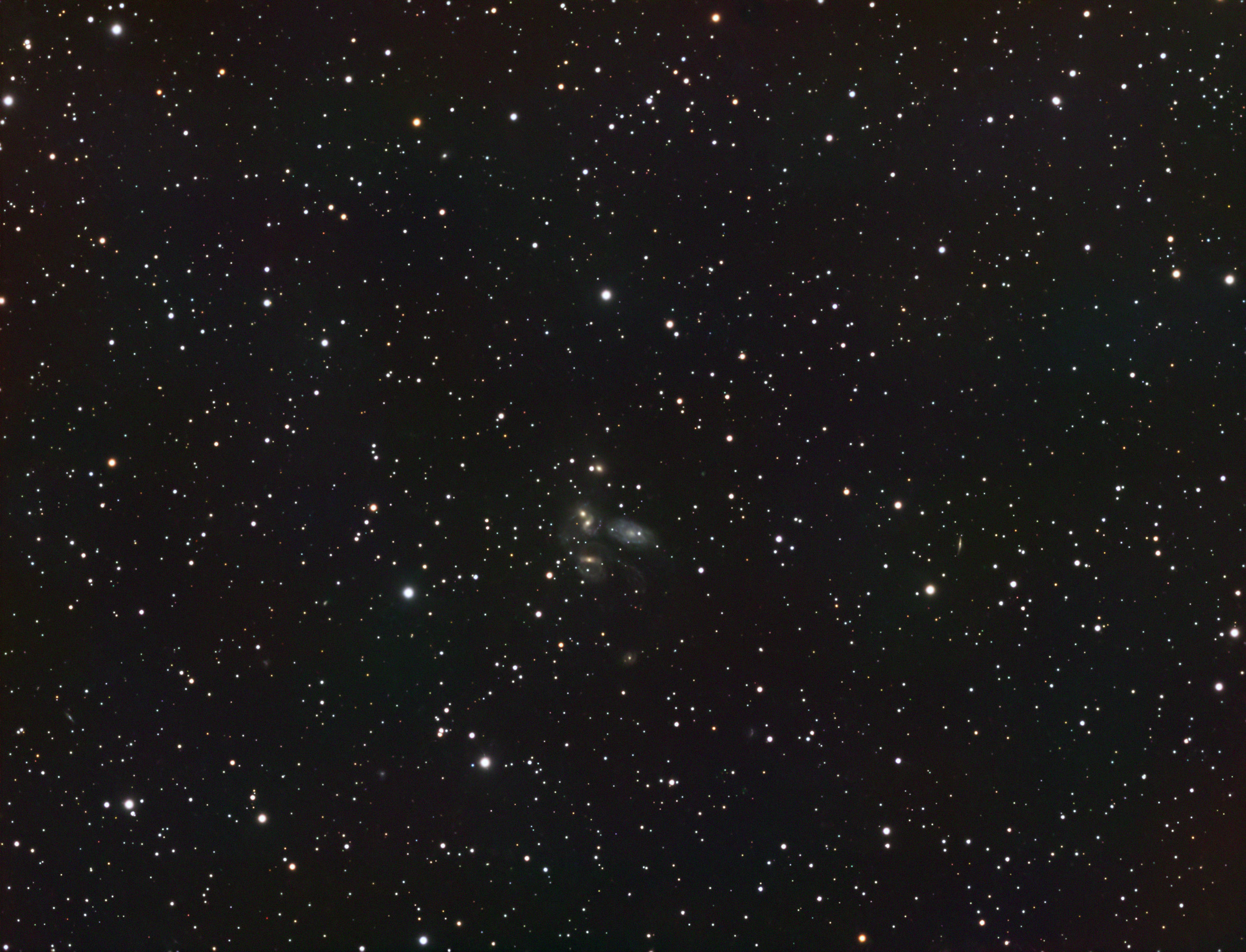
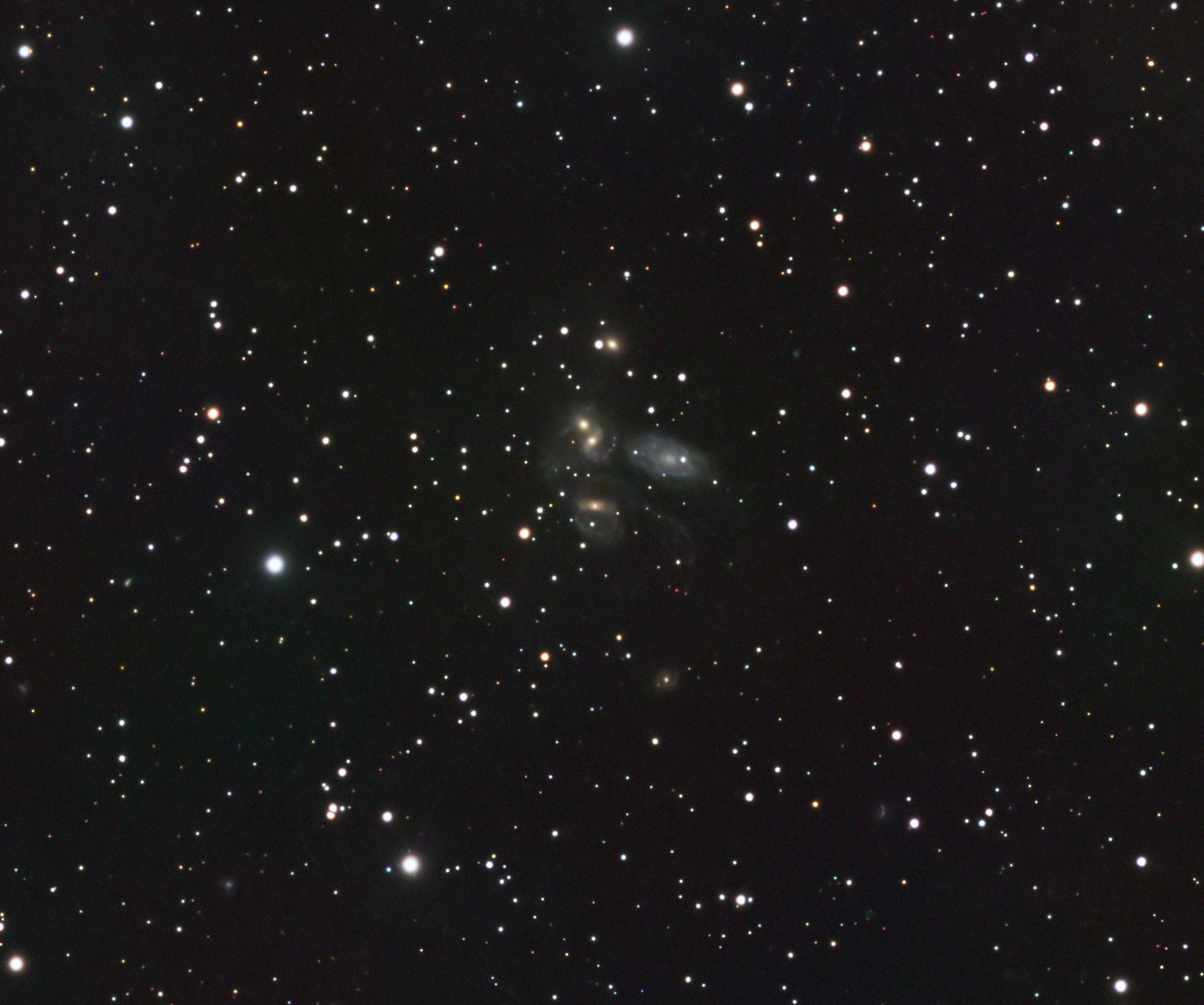
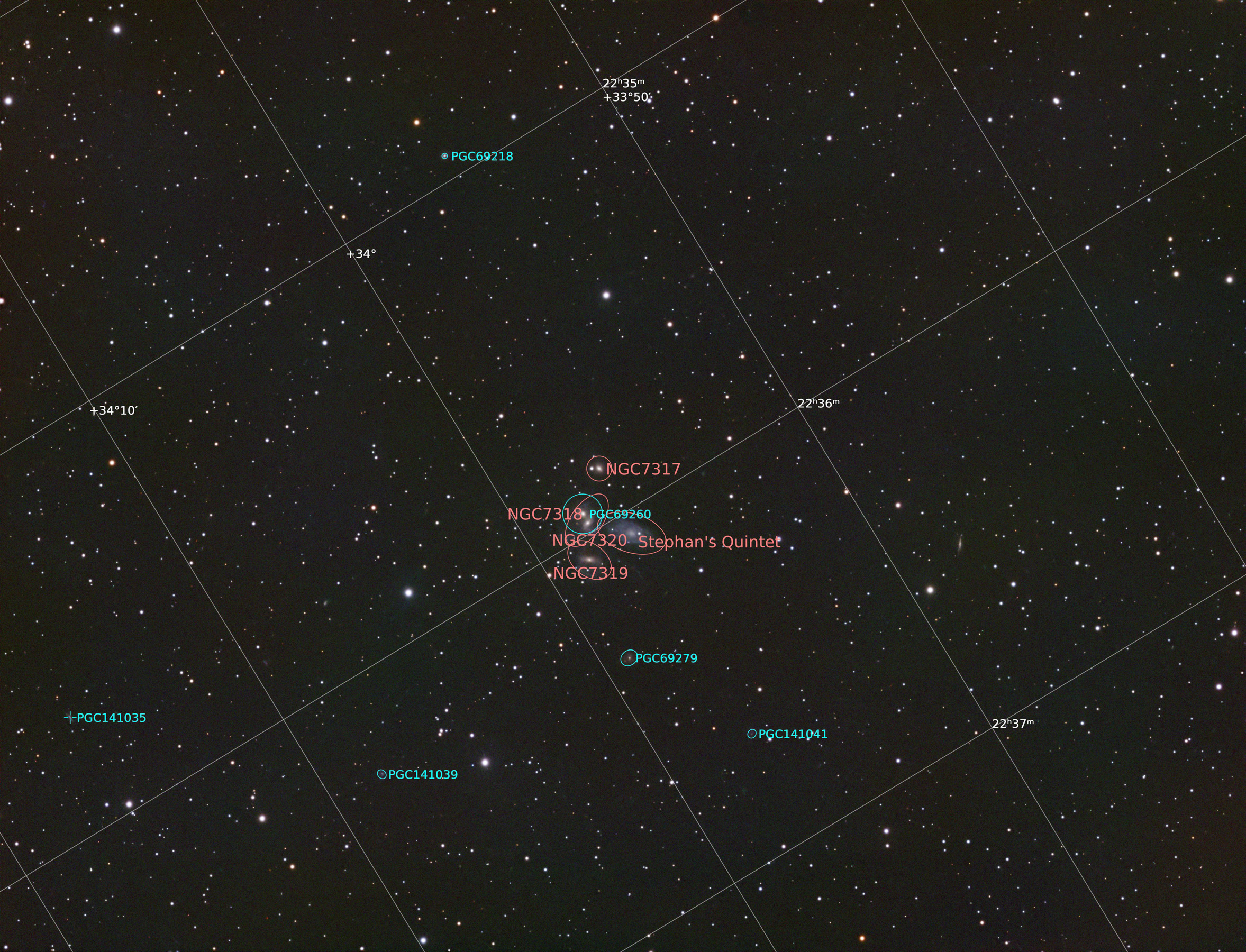
Stephan’s Quintet is a visual grouping of five galaxies of which four form the first compact galaxy group ever discovered. The group, visible in the constellation Pegasus, was discovered by Édouard Stephan in 1877 at the Marseille Observatory. The group is the most studied of all the compact galaxy groups. The brightest member of the visual grouping (and the only non-member of the true group) is NGC 7320, which has extensive H II regions, identified as red blobs, where active star formation is occurring. NGC 7320 lies at a distance of about 39 million light years from Earth.
Four of the five galaxies in Stephan’s Quintet form a physical association, a true galaxy group, Hickson Compact Group 92, and will likely merge with each other. Radio observations in the early 1970s revealed a filament of emission between the galaxies in the group. This same region is also detected in the faint glow of ionized atoms seen in the visible part of the spectrum as a green arc. These galaxies lie at a distance of about 270 million light years from Earth.
Space telescopes have provided new insight into the nature of the filament, which is now believed to be a shock-wave in the intergalactic gas, caused by one galaxy (NGC 7318B) falling into the center of the group at several million kilometres per hour.