Skip to content
Menu
Rolf's Astrophotography
  • An Astrophotography Journey!
  • Clusters
    • Globular Clusters
      • NGC 2419 – The Intergalactic Wanderer
      • M13 – Hercules Cluster
      • M15 – Great Pegasus Cluster
      • M2
      • M3
      • M56
      • M92
      • NGC 6934
      • NGC 7006
    • Open Clusters
      • IC 348
      • M34
      • M35 and NGC 2158
      • NGC 6940
      • NGC 7243
      • M39
      • M45 – The Pleiades
      • M52
      • NGC 869 and NGC 884 – Perseus Double Cluster
  • Galaxies
    • Galaxy Clusters
      • Abell 2197
      • Abell 2199
      • Abell 262
      • Abell 347
      • Abell 426
      • Stephan’s Quintet
    • Elliptical Galaxies
      • Leo I (UGC 5470, PGC 29488, MCG)
      • M105, NGC 3384, and NGC 3389
      • NGC 2537 – Bear Paw Galaxy
      • NGC 3077
      • NGC 3626
      • NGC 4125 and NGC 4121
      • PGC 60095 – Draco Dwarf Galaxy
      • M87 – Virgo A
      • Markarian’s Chain with M84, M86, and M87
      • NGC 1272, NGC 1275 – The Perseus Cluster
      • NGC 3613, NGC 3619, and NGC 3625
      • NGC 3998
      • NGC 4889 and other galaxies in Coma Berenices
      • PGC 2641182
    • Irregular Galaxies
      • NGC 4214
      • M82 – Cigar Galaxy
      • NGC 2366 and NGC 2363
      • NGC 4449
    • Spiral Galaxies
      • IC 2574 – Coddington’s Nebula
      • M74
      • M88
      • M95
      • NGC 3198
      • NGC 3614
      • NGC 3718 and NGC 3729
      • NGC 3726
      • NGC 3938
      • NGC 3945, NGC 3975, and NGC 3978
      • NGC 4041 and NGC 4036
      • NGC 4051
      • NGC 4145
      • NGC 4151 and NGC 4156
      • NGC 4395
      • NGC 4438 and 4435 – The Eyes Galaxies
      • NGC 4725
      • NGC 7479
      • NGC 7814
      • UGC 3697 – Integral Sign Galaxy
      • IC 342
      • M100
      • M101 – Pinwheel Galaxy
      • M102 – Spindle Galaxy
      • M106
      • M108
      • M109
      • M31 – Andromeda Galaxy
      • M33 – Triangulum Galaxy
      • M51 – Whirlpool Galaxy
      • M63 – Sunflower Galaxy
      • M64 – Black Eye Galaxy
      • M65, M66, and NGC 3628 – The Leo Triplet
      • M81 – Bode’s Galaxy and M82 – Cigar Galaxy
      • M94
      • M96
      • NGC 2403
      • NGC 2683 – UFO Galaxy
      • NGC 2775
      • NGC 2841
      • NGC 3184
      • NGC 3642
      • NGC 4236
      • NGC 4244 – Silver Needle Galaxy
      • NGC 4490 – Cocoon Galaxy
      • NGC 4559
      • NGC 4565 (C38) – Needle Galaxy
      • NGC 4631 (Whale Galaxy) and NGC 4656
      • NGC 5005
      • NGC 5216, NGC 5218 – Keenan’s System
      • NGC 5907 – Knife Edge Galaxy
      • NGC 6946 – Fireworks Galaxy
      • NGC 7331
      • NGC 891 – Silver Galaxy
      • NGC 925 – Amatha Galaxy
    • The Milky Way
  • Nebulas
    • Dark Nebulas
      • IC 434 – Horsehead Nebula
      • NGC 2264 – Cone Nebula and Christmas Tree Cluster
    • Emission Nebulas
      • Cederblad 214
      • IC 1470
      • IC 410 – Tadpole Nebula
      • Sh 2-261 – Lower’s Nebula
      • IC 1396 – Elephant’s Trunk Nebula
      • IC 1805 – Heart Nebula
      • IC 1848 – Soul Nebula
      • IC 2177 – Seagull Nebula
      • IC 405 – Flaming Star Nebula
      • IC 5070 – Pelican Nebula
      • IC 5146 – Cocoon Nebula
      • IC 59 and IC 63 – Gamma Cassiopeia Nebula
      • M42 – Orion Nebula
      • NGC 1491
      • NGC 1499 – California Nebula
      • NGC 1931 and IC 417
      • NGC 2174 – Monkey Head Nebula
      • NGC 2237 – Rosette Nebula
      • NGC 2359 – Thor’s Helmet
      • NGC 281 – Pacman Nebula
      • NGC 6888 – Crescent Nebula
      • NGC 7000 – North America Nebula
      • NGC 7635 – Bubble Nebula
      • NGC 7822
      • NGC 896
      • Sadr and the Gamma Cygni Nebula (IC 1318)
      • Sh 2-155 – Cave Nebula
    • Planetary Nebulas
      • NGC 2022
      • NGC 2371-2
      • NGC 2392 – Eskimo Nebula
      • Sh 2-290 (ACO 31)
      • Abell 21 – Medusa Nebula
      • Jones-Emberson 1 Nebula
      • M27 – Dumbbell Nebula
      • M57 – Ring Nebula
      • M76 – Little Dumbbell Nebula
      • M97 – Owl Nebula
      • NGC 1501
      • NGC 40 – Bow Tie Nebula
      • NGC 6543 – Cat’s Eye Nebula
      • NGC 6826 – Blinking Planetary
      • NGC 7662 – Snowball Nebula
    • Reflection Nebulas
      • NGC 1977 – Running Man Nebula
      • IC 2118 – Witch Head Nebula
      • M78
      • NGC 7023 – Iris Nebula
    • Supernova Remnants
      • IC 443 – Jellyfish Nebula
      • M1 – Crab Nebula
      • NGC 6960 – Veil Nebula
  • Solar System
    • Comets
      • Comet C/2024 E1 (Wierzchos))
      • Comet C/2025 A6 (Lemmon)
      • Comet Tsuchinshan-ATLAS (C2023 A3)
    • The Moon
    • Jupiter
    • Mars
    • Saturn
  • Stars
    • Double Double in Lyra
    • Gemini Constellation with Jupiter
    • Orion Constellation
  • The Gear
    • APO107 Configuration Example
    • APO94 Configuration Example
    • AstroTrac TT320X and Nikon D800 DSLR Configuration Example
    • MN190 Configuration Example
    • RC8″ Configuration Example
    • Skywatcher EQ6-R Pro Equatorial Mount
Rolf's Astrophotography

NGC 4438 and 4435 – The Eyes Galaxies

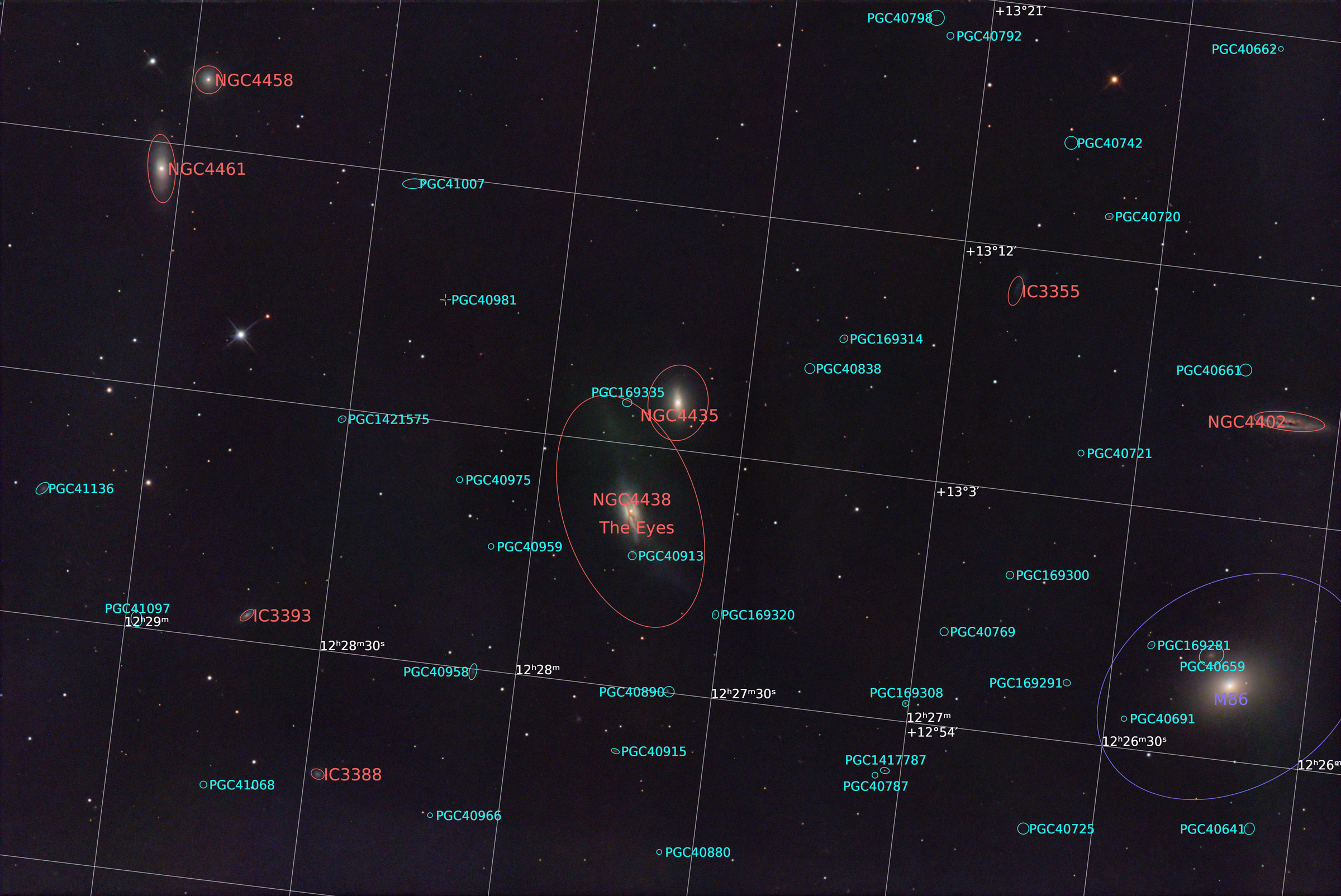
The Eyes Galaxies (NGC 4435 and NGC 4438) are a pair of galaxies about 52 million light-years away in the constellation Virgo. The pair are members of the string of galaxies known as Markarian’s Chain.

NGC 4435

NGC 4435 is a barred lenticular galaxy currently interacting with NGC 4438. Studies of the galaxy by the Spitzer Space Telescope revealed a relatively young (190 million years) stellar population within the galaxy’s nucleus, which may have originated through the interaction with NGC 4438 compressing gas and dust in that region, triggering a starburst. It also appears to have a long tidal tail possibly caused by the interaction; however, other studies suggest the apparent tail is actually foreground galactic cirrus within the Milky Way unrelated to NGC 4435.

NGC 4438

NGC 4438 is the most curious interacting galaxy in the Virgo Cluster, due to the uncertainty surrounding the energy mechanism that heats the nuclear source; this energy mechanism may be a starburst region, or a black hole-powered active galactic nucleus (AGN). Both hypotheses are currently under investigation by astronomers.

This galaxy shows a highly distorted disk, including long tidal tails due to the gravitational interactions with other galaxies in the cluster and its companion. The aforementioned features explain why sources differ as to its classification, defining it either as a lenticular or spiral galaxy. NGC 4438 also shows signs of a past, extended – but modest – starburst, a considerable deficiency of neutral hydrogen, as well as a displacement of the components of its interstellar medium – atomic hydrogen, molecular hydrogen, interstellar dust, and hot gas – in the direction of NGC 4435. This observation suggests both a tidal interaction with NGC 4435 and the effects of ram-pressure stripping as NGC 4438 moves at high speed through Virgo’s intracluster medium, increased by the encounter between both galaxies.
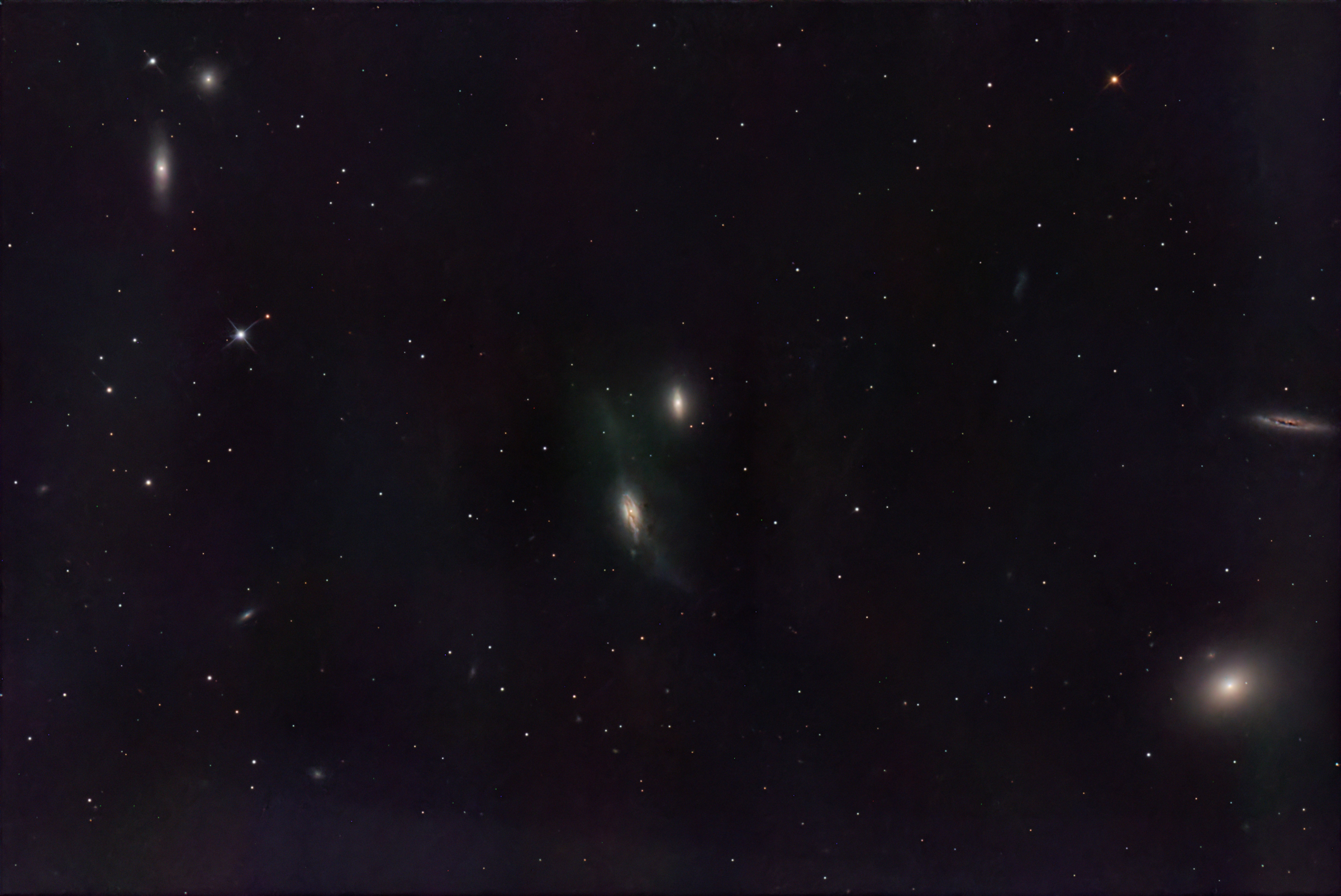
NGC 4438 and NGC 4435, The Eyes Galaxies
Photographed with the RC8″ reflector and the ASI 2600MC color CMOS camera in Stuvsta, April 11th, 2026. Exposure was 30*3 min with IDAS LPS P3 filter. Postprocessing in Pixinsight.
NGC 4438 and NGC 4435, The Eyes Galaxies
Photographed with the RC8″ reflector and the ASI 2600MC color CMOS camera in Stuvsta, April 11th, 2026. Exposure was 30*3 min with IDAS LPS P3 filter. Postprocessing in Pixinsight.
©2026 Rolf's Astrophotography | WordPress Theme by Superb WordPress Themes