NGC 891 (also known as Caldwell 23 and Sliver Galaxy) is an edge-on unbarred spiral galaxy about 30 million light-years away in the constellation Andromeda. The galaxy is a member of the NGC 1023 group of galaxies in the Local Supercluster. It has an H II nucleus.
NGC 891 looks as the Milky Way would look like when viewed edge-on and in fact both galaxies are considered very similar in terms of luminosity and size.
NGC 891
NGC 891 (also known as Caldwell 23) is an edge-on unbarred spiral galaxy about 30 million light-years away in the constellation Andromeda. It was discovered by William Herschel on October 6, 1784. The galaxy is a member of the NGC 1023 group of galaxies in the Local Supercluster. It has an H II nucleus.
Photographed with the CPC 9,25″ reflector telescope and Nikon D800 camera in Åva, November 2015. Exposure was 4 * 90s. at ISO 800..
NGC 891
NGC 891 (also known as Caldwell 23 and Sliver Galaxy) is an edge-on unbarred spiral galaxy about 30 million light-years away in the constellation Andromeda. The galaxy is a member of the NGC 1023 group of galaxies in the Local Supercluster. It has an H II nucleus.
NGC 891 looks as the Milky Way would look like when viewed edge-on and in fact both galaxies are considered very similar in terms of luminosity and size.
Photographed with the APO107 refractor telescope and the Atik 360EX CCD camera from Stuvsta in January 2019. Exposure was approx. 17 min each of RGB, and the guide error was less than 10″.
NGC 891
NGC 891 (also known as Caldwell 23 and Sliver Galaxy) is an edge-on unbarred spiral galaxy about 30 million light-years away in the constellation Andromeda. The galaxy is a member of the NGC 1023 group of galaxies in the Local Supercluster. It has an H II nucleus.
NGC 891 looks as the Milky Way would look like when viewed edge-on and in fact both galaxies are considered very similar in terms of luminosity and size.
Photographed with the APO107 refractor telescope and the Atik 360EX CCD camera from Stuvsta in January 2019. Exposure was approx. 17 min each of RGB, and the guide error was less than 10″.
NGC 891, Silver Galaxy
Photographed with the RC8″ reflector telescope and ASI 2600MC CMOS color camera in Stuvsta, January 3rd, 2025. Exposure was 30 * 3 min with HEUIB filter and bin 2×2. There was no moon and the temperature was -10 centigrade. Postprocessing in Pixinsight and Photoshop.
NGC 891, Silver Galaxy
Photographed with the RC8″ reflector telescope and ASI 2600MC CMOS color camera in Stuvsta, January 3rd, 2025. Exposure was 30 * 3 min with HEUIB filter and bin 2×2. There was no moon and the temperature was -10 centigrade. Postprocessing in Pixinsight and Photoshop.
NGC 891
Photographed with the MN 190 mm reflector and Atik 360EX monchrome CCD camera in Stuvsta on November 15th and 16th, 2025. Exposure was 40 min for each of R, G, and B, 52 min for L and 40 min for Ha. Postprocessing in Pixinsight with Blur Xterminator and in Photoshop to add star spikes.
NGC 891
Photographed with the MN 190 mm reflector and Atik 360EX monchrome CCD camera in Stuvsta on November 15th and 16th, 2025. Exposure was 40 min for each of R, G, and B, 52 min for L and 40 min for Ha. Postprocessing in Pixinsight with Blur Xterminator and in Photoshop to add star spikes.
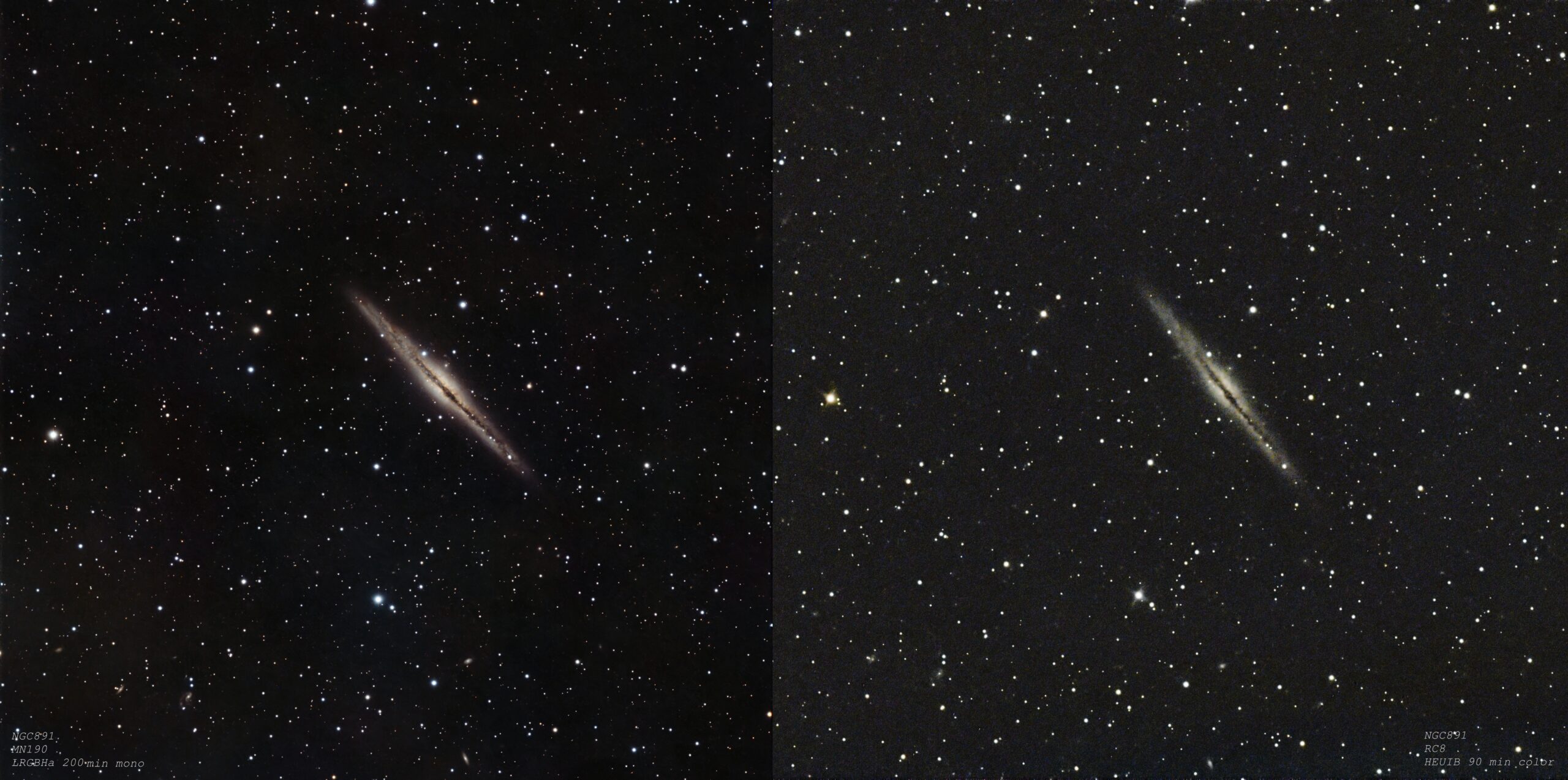
Here is a comparison of two NGC 891 images by two different telescopes and cameras, cropped and rotated to the same size. (Click image for an enarged view!)
The left image was taken by the 190 mm Maksutov Newton Teleskop (focal length 1000 mm, f 6.3) and the Atik 360EX monochrome CCD camera (2750 x 2200 pixels of 4,54 my), and R, G, B, and Ha filters with 7 nm passband width + an L filter. Exposure was 40 min per filter, i.e. a total exposure time of 200 min.
The right image was taken by the 203 mm Ritchey-Chretien Telescope (focal length 1624 mm, f 8) and the ZWO ASI2600MC color CMOS camera at bin 2 (3124 x 2088 pixels of 7,52 my), and an L-filter stopping IR and UV light. Exposure was a total of 90 minutes.
In both pictures autoguiding was by an OAG and PHD2. There was no reducer at the telescopes and no apparent moon. Postprocessing was done similarly by Pixinsight, BlurXterminator, and NoiseXterminator.